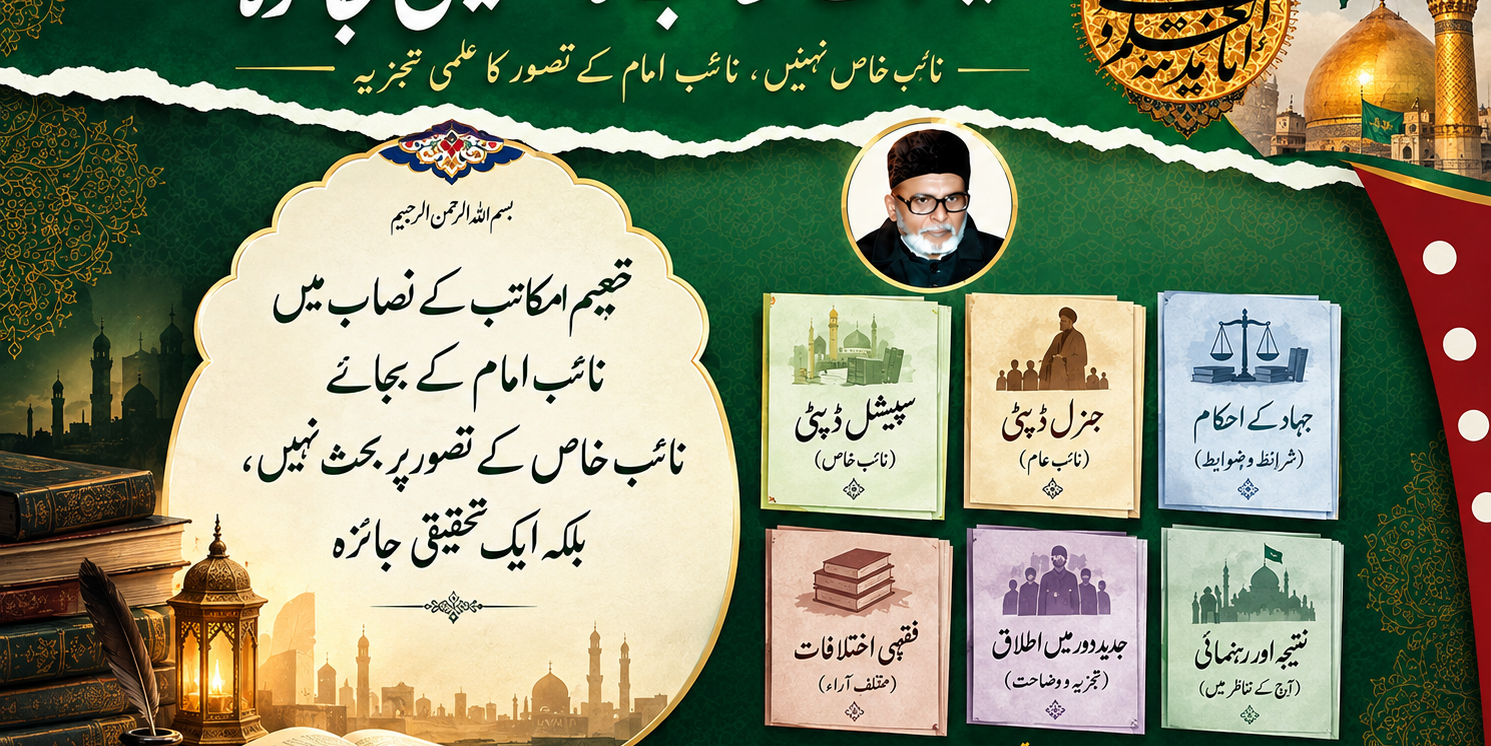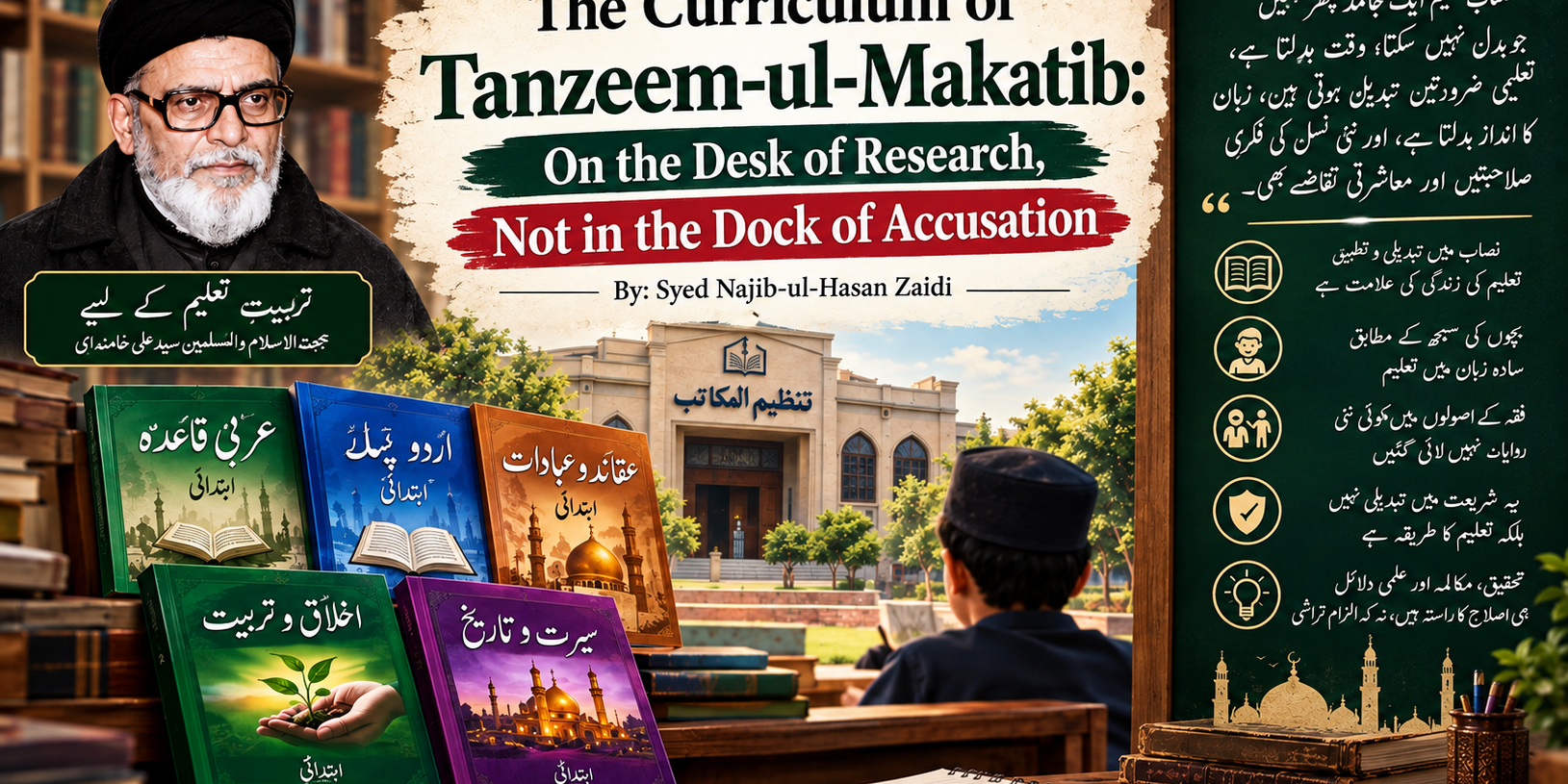
The Curriculum of Tanzeem-ul-Makatib: On the Desk of Research, Not in the Dock of Accusation

In the Name of Him, the Most High.
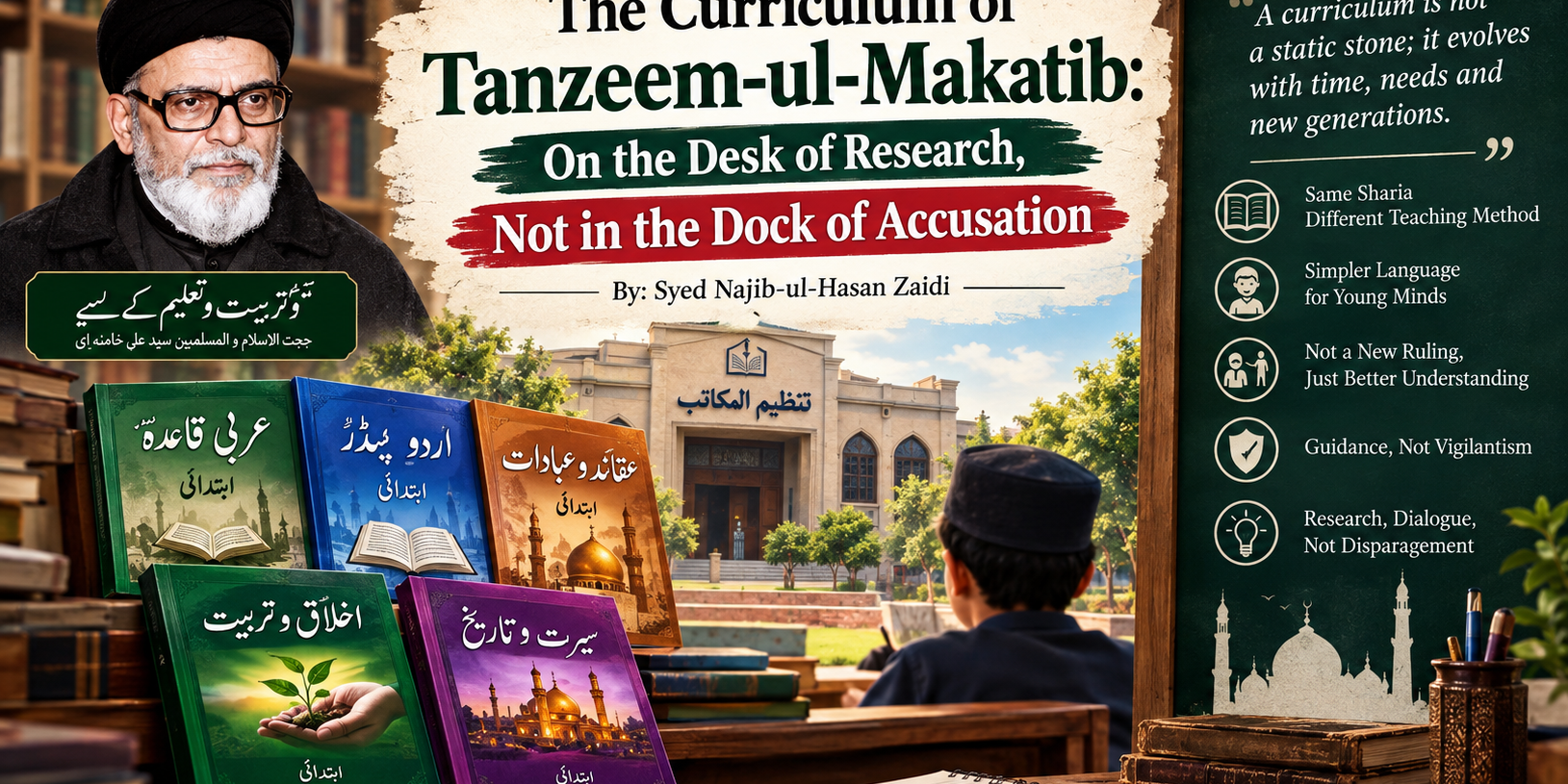
When discussing the educational curriculum of any institution, school, or seminary (madrasa), the fundamental reality to keep in mind is that a curriculum is not a static stone incapable of change. Times change, educational requirements evolve, linguistic styles shift, and children’s intellectual capacities and societal needs transform. Consequently, curricula are periodically modified, reorganized, condensed, expanded, and modernized.
Evolution in Educational Curricula: A Sign of Vitality
Across the world's most prominent educational systems, updating a syllabus to meet the needs of a new generation is not a flaw; rather, it is a hallmark of educational vitality. If an Islamic educational institution alters the style, structure, examples, language, chapters, or pedagogical methods of its textbooks, what justification is there for objection?
- Does every revised phrasing signify a new Sharia?
- Does reorganizing a textbook imply altering jurisprudence (Fiqh)?
- Does simplifying a complex jurisprudential term into accessible language constitute an unauthorized tampering with religious law?
If that were the case, why have scholars composed commentaries, marginalia, summaries, elucidations, and annotations on Fiqh for centuries?
The reality is that Sharia is one matter, while the methodology of teaching it is another. Tanzeem-ul-Makatib has not altered the fundamentals of Sharia; rather, it has sought to convey the principles formulated by the jurists of the Ahl al-Bayt (peace be upon them) in simplified language suitable for the intellectual level of young students.
The Distinction Between Dars-e-Kharij and an Elementary Curriculum
When a Mujtahid (jurist) delivers an advanced seminar (Dars-e-Kharij) addressing the conditions, caveats, exceptions, and secondary branches of an issue, his audience consists of seminary scholars and researchers. These lectures span years, face scholarly scrutiny, undergo compilation, receive annotations, and spark intensive debates. Subsequently, legal rulings (Fatawa) emerge in their light—often even shifting as a result of ongoing deliberation.
Conversely, when conveying basic religious concepts to an elementary student in a primary seminary, does the instructor initiate a Dars-e-Kharij debate or place dense, intricate jurisprudential passages directly before the child? Doing so would not help the child comprehend jurisprudence; it would only cause them to dread it as an incomprehensible monster.
For this reason, the function of a curriculum is not to transcribe jurisprudential treatises verbatim, but rather to translate legal principles into pedagogical language. The scholars and educators who compiled the curriculum of Tanzeem-ul-Makatib accomplished precisely this:
- They did not usurp the position of jurists to issue independent rulings.
- They did not invent new religious obligations.
- They did not declare the forbidden lawful or the lawful forbidden.
- They merely endeavored to present the intricate terms of jurists in language a child can understand.
This is not an alteration of divine law; it is the craft of pedagogy.
Misunderstandings Regarding Permission for Jihad by the Deputy of the Imam
If an objection is raised against a specific phrase concerning Jihad in the Tanzeem-ul-Makatib curriculum, one must first examine its underlying meaning. If a child is taught that Jihad is not an arbitrary, vigilante, or unregulated armed initiative, but rather a grave legal matter bound to legitimate religious leadership and authorized authority, then labeling this foundational concept incorrect reveals an unfamiliarity with jurisprudential history.
An official legal inquiry published on the office website of Grand Ayatollah Sistani states explicitly:
“Jihad alongside the Infallible (peace be upon him) or his specific deputy is obligatory, and it is a Shar'i ruling.”
This is not a novel stance; classical jurists deduced this exact principle from early traditions:
“Jihad is a collective obligation (Wajib Kifa'i), mandatory upon those summoned to it by the Imam; it takes place alongside the just Imam or one whom the Imam designates for it.”
Shaikh al-Tusi writes in Al-Nihayah:
“Jihad alongside oppressive rulers is unlawful; it is obligatory only alongside the just Imam or one commanded by the Imam to undertake it.”
Allamah al-Hilli affirms in Tadhkirat al-Fuqaha:
“Jihad is a collective obligation, and it is not obligatory except alongside the just Imam or his specific deputy.”
Shahid al-Thani writes in Masalik al-Afham concerning primary/offensive Jihad (Al-Jihad al-Ibtida'i):
“The presence of the Imam or his specific deputy is a condition for the obligation of primary Jihad; thus, during the Major Occultation, it is not legislated under this title.”
If a textbook summarizes this complex debate for a child by stating:
“Jihad can only occur with the permission of the Prophet, the Imam, or the deputy of the Imam,”
how can declaring this “contrary to Sharia” reflect sound legal discernment? It is simply the translation of a fundamental jurisprudential precept into accessible educational prose.
Naturally, advanced jurisprudence clarifies the critical distinctions between primary Jihad, defensive combat (Qital Difa'i), the Infallible Imam, the specific deputy (Na'ib-e-Khas), the era of Occultation, and the defense of Islam. However, presenting the foundational principle to an elementary pupil is no crime. Have jurists not consistently emphasized the stipulations of leadership and authorization?
Centuries of Imami jurisprudence have treated Jihad as a structured legal chapter encompassing debates on the just leader, the deputy, command, permission, invitation, capability, and defense. Tanzeem-ul-Makatib did not fabricate a novel doctrine out of thin air. This jurisprudential heritage already existed; the syllabus merely conveyed it in language suitable for children.
Why Is the Phrasing on Jihad So Concise?
One might ask: If all classifications of Jihad are not identical, why does the curriculum present such a succinct statement?
The answer is self-evident: an introductory curriculum is not an advanced seminary seminar. A young child is introduced first to core principles. Nuances, exceptions, and scholarly disagreements are introduced later as age, capacity, and educational level advance. Subjecting a primary-grade student to every jurisprudential debate would overwhelm them under an excessive cognitive burden rather than educate them. Curricula rely on progressive instruction. A brief statement cannot be branded “erroneous” unless it generates an inherently false impression within its educational context.
The Qualified Jurist and the Fatwa of Jihad in the Modern Era
The contemporary era has practically validated this jurisprudential framework. Grand Ayatollah Sistani’s historic 2014 fatwa against ISIS serves as an essential practical example.
In June 2014, when ISIS seized vast swathes of Iraqi territory and threatened Baghdad, Najaf, and Karbala, the representative of the Supreme Religious Authority (Marja'iyyah) declared in Karbala on June 13, 2014, that confronting this existential threat was a collective duty, designating defense as a collective obligation (Wajib Kifa'i) upon citizens. Capable individuals were summoned to join the official state security apparatus to defend Iraq, its people, and its sanctities. Subsequent clarifications reiterated that this call was strictly intended to bolster official national security forces—not to establish extrajudicial armed militias.
This demonstrates jurisprudence transitioning from theoretical texts into practical reality. The Marja'iyyah formulated this directive with measured caution, preserving legal fidelity without plunging civic order into turmoil. Ayatollah Sistani’s texts distinguish between offensive Jihad alongside the Imam or his specific deputy on one hand, and the defense of Islam (Al-Difa' 'an al-Islam) as an independent legal category on the other.
Jihad is neither an individual nor an unregulated initiative; it requires structured titles and qualified leadership. When the necessity for defense arose, contemporary religious authority made its legal position unequivocally clear. What fault, then, lies with Tanzeem-ul-Makatib?
- Did it alter jurisprudence? No.
- Did it invent a new principle in Sharia? No.
- Did it reject the rulings of the jurists? No.
- Did it engineer an unauthorized framework for Jihad? No.
It simply translated an intricate legal reality into terms accessible to children. If that constitutes an offense, then all commentaries, translations, summaries, and educational materials across the Islamic world stand equally guilty.
Changing a Syllabus Does Not Mean Changing the Sharia
This principle warrants the utmost clarity: curricula evolve; Sharia does not.
- Book covers change.
- Lesson sequences change.
- Illustrative examples change.
- Linguistic styles change.
- Dense phrasing can be simplified.
- Redundancies can be removed.
- Modern examples can be added for newer generations.
- Arabic passages can be explained through Urdu vernacular.
None of these pedagogical shifts alters divine law itself. When an issue previously expressed in archaic diction is rewritten in modern, straightforward prose, the ruling remains intact; only the teaching approach has adapted. Equating every textual revision in a textbook with "inventing a new Sharia" is an unscholarly approach—tantamount to wielding a sledgehammer where one needs a pen.
Reforming Religious Institutions Through Scholarship, Not Disparagement
Those who disagree with specific phrasings in the Tanzeem-ul-Makatib curriculum should adopt an academic methodology:
- Present the original text accurately.
- Outline its jurisprudential meaning.
- Cite the relevant rulings of classical and contemporary jurists.
- Assess whether the syllabus contradicts these rulings or merely renders them in plain terms.
- If genuine revision is required, offer constructive, scholarly rectifications.
Institutions are reformed through rigorous research, dialogue, and evidence—not through institutional disparagement. To those criticizing the syllabus, the question must be posed: If the original principle states:
“Jihad alongside the Infallible or his specific deputy…”
and the elementary text captures this by using the phrase "the Prophet, the Imam, or the deputy of the Imam," which specific divine decree has been subverted? Differences in introductory phraseology do not nullify underlying jurisprudential principles. The debate should center on scholarly integrity, not linguistic pedantry.
Tanzeem-ul-Makatib did not invent Sharia; it endeavored to convey it to children. It did not displace jurists; it rendered their words into child-friendly concepts. It did not alter the language of the Quran; it connected students to the Quran through foundational Arabic primers. It did not impose Urdu over religion; it used Urdu readers to convey cultural and religious heritage in a familiar tongue.
A Critical Precaution in Pluralistic, Democratic Societies Like India
In the context of India's unique sociopolitical landscape, this clarification carries vital practical weight. Emphasizing that Jihad cannot occur without the explicit sanction of an authorized, accountable religious authority is not just an abstract jurisprudential detail; it articulates an essential civic and religious safeguard within a multi-religious, democratic society.
Under the jurisprudence of the Ahl al-Bayt (peace be upon them), Jihad is never surrendered to the whims of individuals, clandestine groups, or self-proclaimed commanders. A person cannot extract isolated Quranic or hadith passages to self-identify as a combatant, designate their associates as an army, and rebrand personal political agendas as sacred struggle. For this reason, conflating vigilante extremist entities like ISIS with authentic Islamic Jihad is untenable both legally and academically.
The chapter on Jihad in the Tanzeem-ul-Makatib syllabus must be evaluated through this lens: conditioning Jihad on the permission of the Imam or authorized leadership does not license lawlessness; on the contrary, it shields society from vigilantism, sectional interests, and rogue factions.
The View of Grand Ayatollah Sayyid Abu al-Qasim al-Khoei and the Governance of the Jurist (Wilayat al-Faqih)
Jurisprudential positions are dynamic in their application to emerging political and social realities during the Occultation. When this syllabus was originally compiled, the practical model of Wilayat al-Faqih embodied in modern governance was not yet established. Consequently, discussions of primary Jihad typically cited classical formulations requiring the Infallible Imam or his specific deputy (Na'ib-e-Khas).
However, must subsequent legal discernment remain permanently frozen in historical phrasing?
When a fully qualified jurist (Faqih Jami' al-Shara'it) assumes broader social responsibility, and when sovereign governance involves territorial defense, international relations, public peace, and community welfare, the question arises: can a jurist be acknowledged as a legitimate governing authority while simultaneously denied the prerogatives necessary to maintain societal preservation?
According to explicit rulings of contemporary jurists, if a fully qualified jurist oversees the general affairs of the Muslim community and overriding public welfare (Maslahah) necessitates it, the authorization of primary Jihad is not precluded. This is an organic jurisprudential deduction rooted in the relationship between authority, governance, and communal interest.
Similarly, in the jurisprudence of Grand Ayatollah Sayyid Abu al-Qasim al-Khoei, the matter was examined beyond a simplistic binary of whether offensive Jihad is permissible during the Occultation. His discussions engaged with general deputyship, social preservation, and the scope of administrative prerogatives (Al-Umur al-Hasbiyyah).
Therefore, the historical phrasing in Tanzeem-ul-Makatib's original curriculum must be read within its proper historical context rather than artificially juxtaposed against contemporary models of Islamic governance to claim that jurisprudence underwent an illicit rupture.
The Fundamental Question for the Critic
If a critic acknowledges the authority of a qualified jurist over public order, border security, defense, and collective welfare, how can one categorically exclude foundational defense prerogatives from that scope merely because earlier texts employed the terminology of "specific deputy"? How does one reconcile general deputyship (Na'ib-e-Amm) and administrative authority during the Occultation with classical phraseology?
The strength of Shia jurisprudence lies not in freezing historical phrases in time, but in preserving scriptural principles while formulating reasoned answers for every new societal phase.
Fairness demands evaluating the syllabus within its pedagogical context and assessing contemporary legal positions within their modern frameworks. This curriculum neither provides a pathway to extremism nor grants individuals the license for vigilante violence.
Those attempting to place an entire syllabus in the dock over a concise textbook sentence must re-examine the centuries-old corpus of Imami scholarship, review Ayatollah Sistani's legal rulings, examine the 2014 defense fatwa, and recognize that defensive warfare and primary Jihad represent distinct jurisprudential categories.
The division of roles remains straightforward:
- Jurists deduce the principles.
- Instructors explain them.
- Curricula transmit them to the rising generation.
Curricula will continue to evolve, textbooks will be modernized, and linguistic styles will adapt, while the foundational tenets of Sharia remain steadfast. That balance—standing unshakeable on principle while remaining dynamic in pedagogy—is the defining feature of any living educational system.