Sir Syed Ahmad Khan (RA): An Epoch-Making Visionary, a Dynamic Movement, and a Living Legacy

On the pages of history, some figures earn a place through their achievements, but there are others whose lives become the defining narrative of an entire era. Their ideas transcend the boundaries of their time, serving both as probing questions and guiding lights for generations to come. Sir Syed Ahmad Khan (RA) was precisely such a luminary. He was not merely an individual, but a school of thought; not just a name, but a reformative movement; not simply the founder of an educational institution, but the voice of an era in which Muslims had to rise above collective despair to chart a new course of life. To understand his personality, one must comprehend the India into which he was born, the upheaval that extinguished an empire before his very eyes, and the unyielding resolve that compelled him to kindle the beacon of education amidst the shadows of despondency.
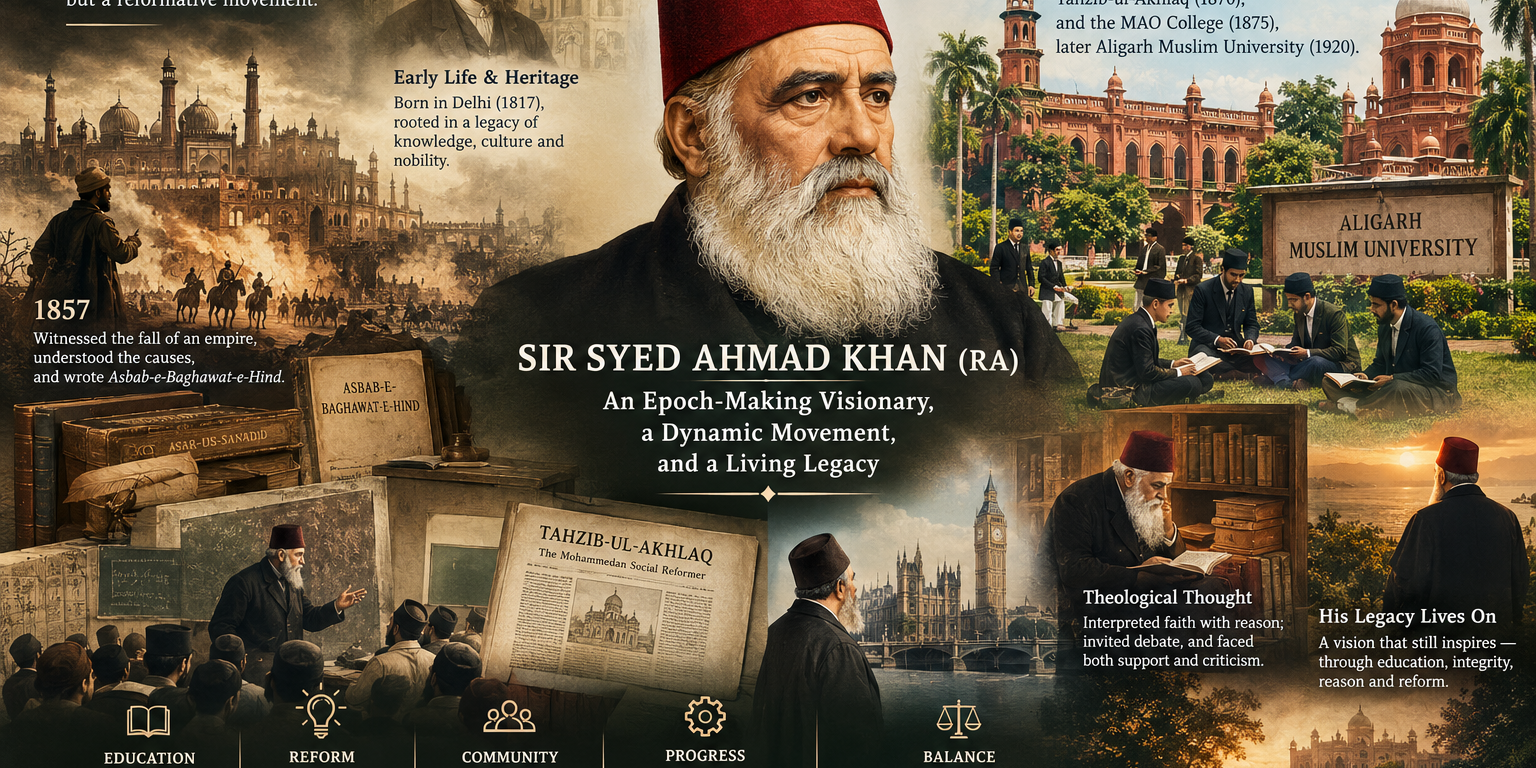
Sir Syed Ahmad Khan was born in Delhi on October 17, 1817. He hailed from a distinguished Sadat family, and his genealogical tree is inscribed upon his tomb. Tradition traces his ancestral lineage from Herat to India. His family was closely associated with the scholarly, cultural, and courtly milieu of the Mughal Empire. Within his household, education in Arabic and Persian, refined etiquette, and intellectual heritage were deeply prized. Sir Syed received his early upbringing in this environment; however, the formation of his character remained far from confined to ancestral nobility or traditional schooling. The trials of life, the shifts of the era, and the decline of society stirred within him an intellectual restlessness that later became the fountainhead of a monumental reform movement.
In 1838, he entered the service of the East India Company. His judicial and administrative responsibilities afforded him firsthand observation of Indian society, the bureaucratic apparatus, and the grievances of the common people. He was not a passive observer of events, but an acute thinker who reflected on their root causes. A sharp historical consciousness, an earnest desire to understand contemporary conditions, and an inclination toward pragmatic problem-solving became hallmarks of his temperament. During this period, he examined Delhi's historical monuments, antiquities, and cultural heritage, a scholarly endeavor that culminated in his renowned work, Asar-us-Sanadid. This monograph stands as an enduring testament to his intellectual caliber, historical insight, and deep attachment to the cultural legacy of his city.
Then erupted the Great Uprising of 1857—a cataclysm that shook not only India's political landscape, but also its social and cultural fabric. The lamp of Mughal sovereignty flickered out, the splendors of Delhi were laid waste, thousands of families were ruined, and a vast segment of the Muslim population was plunged into an acute political, economic, and educational crisis. Sir Syed was stationed in Bijnor at the time. Amid the chaos, he made courageous efforts to save human lives, yet his vision extended far beyond immediate events. He pondered the deeper causes that had ignited such a massive political confrontation and questioned why Indian society suffered such devastating ruin in its aftermath.
The fruit of this contemplation was his seminal treatise, Asbab-e-Baghawat-e-Hind (The Causes of the Indian Revolt). In this work, he identified administrative missteps, public discontent, and flawed governance policies that demanded clear understanding to avert similar catastrophes in the future. It was the writing of a statesman who refused to settle for emotional reactions, striving instead to penetrate the depths of reality and extract vital lessons. Sir Syed sought to make his people realize that lamentation alone was futile following defeat; what was imperative was an objective analysis of internal weaknesses, an accurate grasp of contemporary realities, and practical planning for the future.
In the aftermath of 1857, Muslims faced a critical dilemma: What was to be done now?
One path was to seek refuge in nostalgic tales of past grandeur; another was disillusionment, leading to complete withdrawal from public life; and the third was to understand the evolving world and rebuild collective capabilities anew. Sir Syed chose the third path. He recognized that raw emotion could not restore lost sovereignty, grievances could not eliminate educational backwardness, and resting upon the laurels of the past could never open the doors to the future. What was required was knowledge, organization, social consciousness, and a generation attuned to the demands of its time.
It was at this juncture that Sir Syed transcended his role as a government official to emerge as a national reformer. Recognizing the paramount importance of modern sciences, he concluded that the advancement of Muslims necessitated an educational system that would introduce them to scientific inquiry, modern languages, critical research, and the demands of practical life. In his view, learning the English language was not merely about mastering a foreign tongue; it was the essential conduit to the intellectual and administrative infrastructure that unlocked economic and professional opportunities in British India. He was determined that Muslims should not fall into further marginalization through ignorance of this system.
The establishment of the Scientific Society at Ghazipur in 1864 was a direct practical manifestation of this vision. Through this body, he promoted the translation of modern scientific works, disseminated intellectual literature, and fostered a culture of critical inquiry. In 1866, the Aligarh Institute Gazette was launched, playing an instrumental role in elevating scholarly and social discourses among a wider audience. These initiatives demonstrated that Sir Syed did not seek to transform a nation through solitary speeches or impassioned rhetoric; he aimed to create institutional resources for the continuous dissemination of knowledge, institutional capacity building, and collective intellectual development.
In 1869, he traveled to England, where he keenly observed educational institutions, the intellectual climate, and social systems. This journey helped crystallize his educational blueprint. He realized that educational progress did not rely solely on the acquisition of books; it required structured institutions, trained faculty, rigorous discipline, academic freedom, and an invigorating environment wherein the latent faculties of students could flourish. An enduring vision took root in his mind: to establish an institution that would serve as a bridge between Eastern heritage and modern scientific inquiry.
In 1870, he launched the journal Tahzib-ul-Akhlaq (The Mohammedan Social Reformer). This periodical was not merely a venue for published essays, but a deliberate enterprise for the intellectual and social reformation of Muslims. Through its pages, Sir Syed tackled moral shortcomings, obsolete customs, educational negligence, and regressive social attitudes. He urged Muslims to reassess their way of life, acknowledge their failings, embrace constructive change without fear, and make decisions guided by reason. He was firmly convinced that societal reform could not be achieved merely by altering external circumstances; it demanded an inward transformation of mindset, habits, and priorities.
Ultimately, in 1875, the Madrasat-ul-Uloom was founded in Aligarh, and by 1877, it developed into a full-fledged educational institution: the Muhammadan Anglo-Oriental (MAO) College. This very institution later blossomed into Aligarh Muslim University in 1920. Behind this monumental journey lay decades of tireless exertion, relentless fundraising, patient persuasion of benefactors, and steadfast perseverance in the face of bitter opposition. He understood that founding institutions is arduous, managing them is more difficult still, and integrating them into the fabric of a nation is the greatest trial of all.
The concept of MAO College was of extraordinary historical significance for its era. Its objective was to equip Muslims with modern knowledge, yet Sir Syed never intended it to become a mere imitation of Western education. His aspiration was for Muslims to benefit from modern sciences while preserving their cultural identity. He linked education inextricably with economic progress, moral training, and collective awakening. In his eyes, a nation's honor could not be sustained solely by past glory; it had to cultivate competence in the present and carve out its place in the future.
Herein lies a central facet of Sir Syed's character: he directed his educational mission toward a community reeling from political decline, economic distress, and pervasive despondency. He presented a practical blueprint: acquire knowledge, master new skills, build your own institutions, educate your youth, and remedy your collective frailties. His movement imparted a decisive new direction to debates surrounding modern education across Muslim India. The fruits of this initiative were not confined to his person; his associates, institutions, and subsequent generations carried the mission forward.
Nevertheless, an appraisal of Sir Syed's life remains incomplete without addressing his theological perspectives and the controversies they generated. Nineteenth-century India was undergoing deep religious and intellectual transitions. The concepts of modern science, Western philosophy, colonial rule, and the state of traditional religious seminaries confronted Muslims with questions that yielded no universal consensus. Sir Syed sought to interpret religious texts in the light of reason, observation, and the laws of nature. In his view, there could be no fundamental conflict between sound religious faith and genuine scientific truth.
Yet several of his interpretations provoked fierce disagreement among traditional scholars, particularly regarding miracles, the laws of nature, and rationalist explanations of specific theological matters. Critics contended that in certain areas, Sir Syed subjected the established meanings of canonical texts to reinterpretations that undermined orthodox doctrine. His supporters, on the other hand, argued that he sought to equip Muslims to navigate modern scientific and philosophical skepticism. This was a profound, substantive divergence that cannot be dismissed as mere ignorance on one side or absolute righteousness on the other.
Opposition to Sir Syed encompassed varying motivations. Certain scholars feared the cultural atmosphere of modern educational systems and their potential secularizing effects; others harbored rigorous academic objections to his theological deductions; and in some quarters, opposition deteriorated into personal hostility and decrees of heresy (takfir). These disparate attitudes should not be judged with a single brush. Academic critique must be met with reasoned discourse, whereas personal animosity and baseless vilification undermine genuine intellectual engagement. By the same token, acknowledging an intellectual's monumental public services does not necessitate endorsing every theological view he held.
A balanced evaluation of Sir Syed requires appraising his educational and social contributions distinct from his theological positions, while examining his religious thought through the primary evidence of his own writings. It is neither necessary to reject every concern raised by his critics, nor is it sound to endorse every accusation leveled against him. Intellectual integrity demands treating such divergence as a subject of scholarly inquiry rather than personal character assassination.
His political strategy must likewise be understood within its historical context. Following the turmoil of 1857, Sir Syed prioritized education and gradual social reform over political confrontation with the British administration. He believed that, given the vulnerable condition of Muslims, educational rehabilitation and socio-economic advancement were paramount. Certain contemporaries criticized this approach, while his supporters regarded it as a pragmatic necessity dictated by the realities of the time. While there is legitimate room to critique his political stances, assessing his entire life solely through the lens of his relationship with the colonial government would do grave injustice to history.
Another salient dimension of Sir Syed’s leadership was his refusal to keep the movement centered exclusively on himself. He gathered an exceptional circle of scholars, men of letters, and social reformers who rendered distinguished contributions across diverse fields. The intellectual, literary, and organizational work of figures such as Altaf Hussain Hali, Shibli Nomani, Deputy Nazir Ahmad, Mohsin-ul-Mulk, Viqar-ul-Mulk, Maulvi Zakaullah, and others remains of enduring importance. While they did not share identical viewpoints on every issue, the Aligarh Movement provided a vibrant forum where education, research, social reform, and the collective destiny of the community could be rigorously deliberated.
Sir Syed’s writings mirror his multifaceted intellectual interests. In Asar-us-Sanadid, we find meticulous documentation of historical heritage; in Asbab-e-Baghawat-e-Hind, incisive political analysis; in Khutbat-e-Ahmadiyya, an intellectual defense of the life of the Prophet Muhammad (PBUH); in Tabyin-ul-Kalam, theological and comparative textual study; and in Tahzib-ul-Akhlaq, comprehensive treatises on social reform. These works attest to his ability to engage deeply with the dilemmas of his age from multiple vantage points.
The closing chapter of his life was dedicated entirely to this educational mission. He consistently subordinated personal comfort to the growth of the institution he had founded, pouring his remaining energies into securing its survival and stability. He knew his own days were numbered, but he understood that if the institution stood upon firm foundations, its influence would outlive him by centuries. This embodies the true essence of institution-building: initiating a work that outlasts the founder to benefit future generations.
On March 27, 1898, Sir Syed Ahmad Khan (RA) passed away in Aligarh and was laid to rest within the precincts of the mosque of his beloved institution. His life stands as the chronicle of a leader who transformed education into an instrument of hope amidst decline, challenged intellectual stagnation with critical inquiry, and urged his people toward purposeful action.
Sir Syed should neither be treated as an infallible figure whose every notion demands unquestioning acceptance, nor should his monumental contributions be dismissed out of prejudice. He was a man of his historical moment: he had undeniable triumphs, sharp differences surrounded his ideas, and certain aspects of his political and theological thought invite continued scholarly interrogation. Yet, across all these considerations, the historical significance of his educational movement, his institution-building, his literary endeavors, and his reformative resolve remains undeniable.
The enduring lesson of Sir Syed’s life is that national resurgence is not achieved by eulogizing past glories alone; it demands the relentless pursuit of knowledge, the courage to acknowledge errors, the education and training of the youth, the tolerance of honest dissent, and pragmatic planning for the future. He recognized this imperative in his own era and consecrated his life to its realization. While the wide-ranging outcomes of the movement cannot be attributed to his person alone, history cannot dispute that he created a pivotal turning point in the intellectual and educational journey of South Asian Muslims.
Historical justice requires that Sir Syed be understood in his entirety—within the framework of his era, his philosophy, and his achievements. His public services must be recognized, his ideas engaged with rigorous critique, and his central lesson preserved for the present: progress is unattainable without knowledge, disagreement is unconstructive without reasoned discourse, and reform remains an empty wish without dedicated, practical struggle. This is the enduring message of Sir Syed Ahmad Khan's life and the defining hallmark of his legacy.